
The Four Eras of Tourism
Something has shifted in what destinations ask of their tourism businesses. The expectation used to be growth, plainly stated and easily counted. The expectation now arrives wrapped in a longer set of obligations around carbon, environment, community and cultural identity, while the economic results everyone depends on are still required in full. The plans that carry these obligations are written further up, in strategies and funding programmes and national policy. They are felt furthest down, by the operators delivering the experiences and by the people in destinations whose job is to help them get there.
That gap between where the brief is written and where it is delivered is worth dwelling on, because it shapes a great deal of working life in tourism right now. One way to make sense of it is to notice that tourism has moved through four distinct eras, each built on a different governing question. Seeing which era a given piece of work belongs to brings a welcome clarity to what is actually being asked, and why some of it has become so much harder than it once was.
The Era of Management
For a long time the governing question was straightforward and, for good reason, went largely unquestioned. Tourism is an economic engine, so the task is to grow it. Success was read in arrivals, spend, occupancy and market share, and that logic built the modern industry. A great deal of essential work still belongs here, because strong visitor numbers keep businesses trading and keep people employed. When growth is the whole of the question, the place itself, with its communities and its environment and its cultural life, becomes an asset in service of the figures.
The Era of Mitigation
Growth eventually reaches a scale where it begins to exact a cost, and a further responsibility settles in alongside it, namely to reduce the harm that growth can do. This is the era of sustainability standards and certification, of carrying-capacity studies and visitor dispersal, of measures designed to spread the load across seasons and across places. The governing question has not changed. Growth is still the priority and the place is still an asset, while behaviour is adjusted to soften the impact. Much of the practical, learnable craft of sustainable tourism lives here, and it remains genuinely valuable to the businesses that master it.
The Era of Navigation
Navigation begins when it starts to seem that the growth model itself has become the obstacle. It arrives sooner in places where the strain is already showing, where housing has tightened, where residents have grown weary of the crowds, where a high street has come to serve visitors better than the people who live alongside it, where the landscape carries more than it comfortably can. The work of this era is to keep performing inside a growth-driven system while steering towards something more place-led. It is demanding precisely because the two pull against each other. The targets and the funding still reward the old measures, while the ground underfoot has clearly begun to move. A good many destinations are living in this in-between space today, and it accounts for a particular kind of fatigue among the people working in them.
The Era of Stewardship
In this era the governing question turns over. The work is no longer only how to grow tourism, it is how to grow the place that makes tourism possible in the first place, so that the place stays good to live in and worth travelling to over the long run. Economic performance remains essential, and it now sits nested inside a wider measure of the health of the place. The figures stop being the point and start being one instrument among several. Examples of how this shows up on the ground include tourism that strengthens local food and craft, routes and experiences that serve residents as readily as visitors, a visitor economy that returns something of worth to the place it draws on.
Four eras that sit side by side
These four are best understood as approaches that co-exist, four ways of working that a single destination holds at the same time. A place can be doing clear growth-focused work in one quarter of its activity, careful mitigation in another, and early navigation in a third, all within the same year. Each era grows from a different question and calls for a different kind of capability, and every destination finds itself across its own particular blend, for reasons rooted in its own circumstances.
That said, the overall direction of travel appears to be towards stewardship, which is why we call it The Stewardship Spectrum.
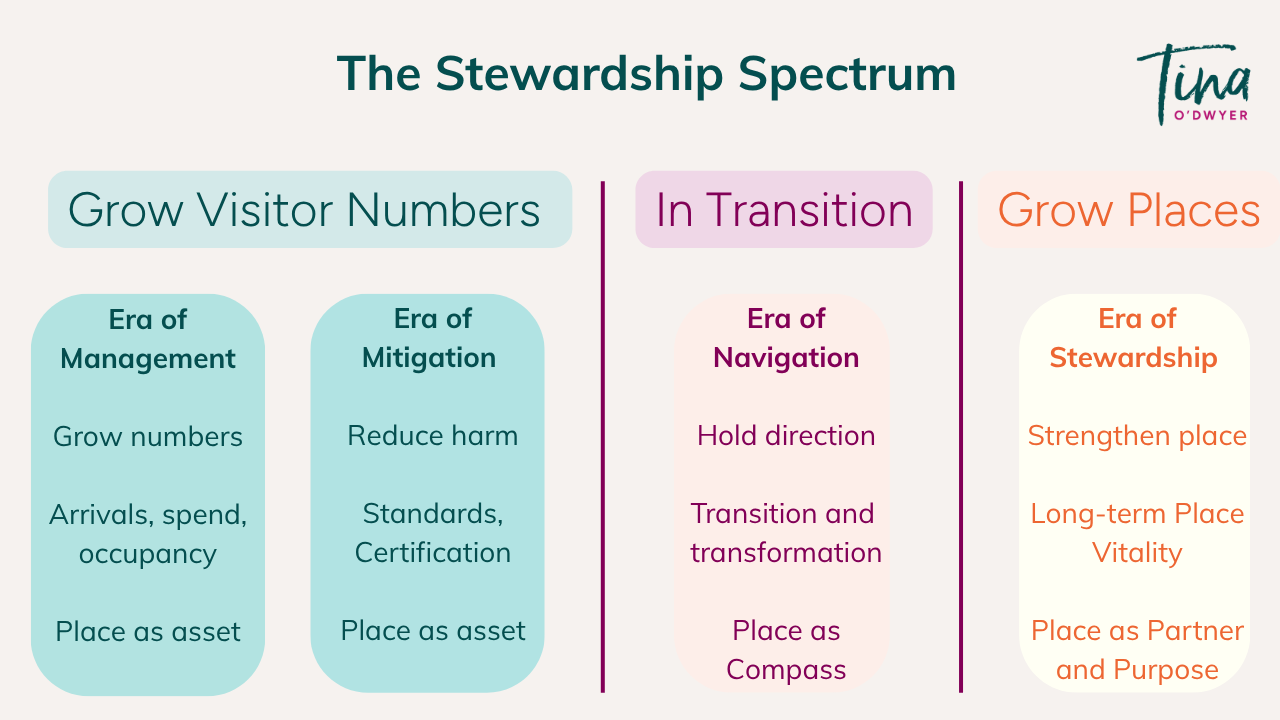
What the Four Eras Model offers is a shared language for an act of balancing that is already under way across the sector. Holding the economy and the place together. Meeting the demands of this year while protecting what the place will need in a decade.
Naming the era you are working in makes the difficulty legible, to a board, to a funder, to a frustrated resident. It makes it easier to find footing in uncertain times.
We follow these questions month by month in Public Sector Tourism Monthly. If the territory is yours too, you are warmly invited to register here.
