
Every Destination Has a Tipping Point
Every destination has a Tipping Point
For a long time, tourism has operated through a simple and powerful assumption: more visitors mean more value.
This has shaped how destinations set targets, report progress and define success. It's a simple story – as visitor numbers grow, the economy grows and a place benefits from more jobs, more investment and more confidence.
For many destinations, this model has delivered real benefit. It has strengthened businesses, supported livelihoods and built host communities.
Yet, tourism has been confronting an uncomfortable question in recent years: is there a point at which more visitors feel like less value to the destination itself?
The blind spot in the numbers
The difficulty with a numbers-first model has become more and more obvious as tourism has grown to epic proportions in some destinations. The numbers simply don’t tell the whole story.
A destination can be performing well economically while residents feel growing pressure. Visitor numbers can rise while housing becomes harder to access, local culture feels thinner, nature carries more strain, or a community begins to feel that tourism is happening to it rather than with it.
In these moments, the economic dashboard is flashing ‘success’ while the place or people are communicating ‘stress’. The place itself may be signalling stress.
That is the blind spot.
If we only track growth in visitor numbers and revenue, we may miss signs that the very place tourism depends on is precariously strained.
Place has a carrying capacity
Every destination has an upper limit in terms of carrying capacity.
Most destinations are nowhere near reaching it. Their immediate task is still to build visibility, strengthen demand, support businesses and grow the visitor economy with confidence.
However, even if a destination is a long way from the threshold, it is important to acknowledge that a threshold exists.
Places are not limitless inputs. They are living systems made up of people, landscapes, culture, infrastructure, memory, identity and everyday life. Tourism draws from all of these. At its best, it also gives back to them.
When it draws too heavily, or returns too little, the balance shifts.
This is where the idea of a Tipping Point becomes useful. It gives language to the moment when more tourism stops being experienced as more value by the people and systems that make the destination possible.
Measuring tourism against place vitality
One way to think differently is to plot visitor numbers against place vitality indicators (in addition to plotting visitor numbers against economic indicators).
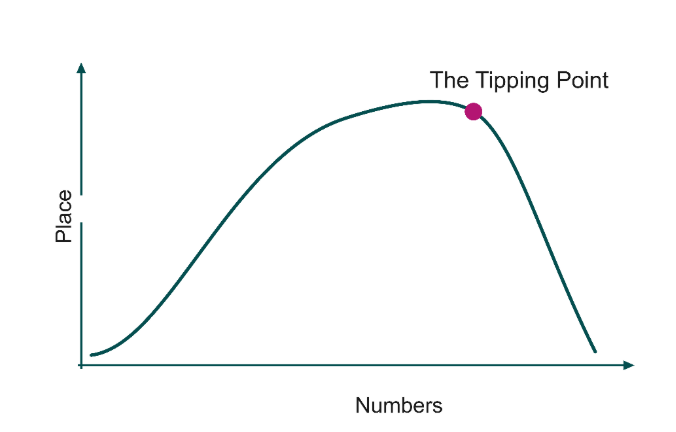
In the early stages of tourism development, visitor numbers and place vitality often rise together. More visitors bring new spending, new enterprise, better facilities and often greater pride in place. Tourism can help a place feel more alive and more full of possibility.
Over time, the perceived added value may begin to level off. Tourism becomes part of daily life. What once felt like new benefit becomes normal. The sense of additional value to the place becomes less obvious.
Further along the curve, perceived value may begin to fall. Residents may avoid their own town at peak times, natural features may show signs of pressure, cultural distinctiveness may feel diluted.
At this point, the numbers may still be rising, which is what makes the Tipping Point so difficult to see from a traditional dashboard.
Tourism is not just another industry
This is one of the reasons to be careful with the word “industry” when speaking about tourism.
Tourism has industry characteristics: it has businesses, jobs, supply chains, markets and performance indicators.
At the same time, tourism is more complex.
It is a system of relationships between visitors, hosts, businesses, communities, public bodies, culture, landscape and nature. It is lived through place. It depends on place staying whole, distinctive and full of life.
Most industries can imagine growth as a line that keeps moving upward. Tourism cannot do this in the same way, because its core asset is not separate from the living place in which it happens.
The quality of the place is the absolute foundation of tourism.
The leadership task now
Over recent years, tourism has had to understand that the numbers are not the only thing that matter. Other key strategic signals are resident feeling, business quality, nature and heritage, the experience of moving through a place, the ability of local people to live, work and prosper in the destination.
Framing these as strategic signals and not just ‘soft measures’ is essential. We can measure these, we can target improvements, we can develop action plans to deliver those targets.
Sometimes the choice is framed more simply: growth or sustainability, economy or stewardship, numbers or values.
This makes the job more difficult for everyone. It’s a binary when in reality we are looking for balance.
The economy does not sit opposite place vitality. It sits inside it. Place vitality gives economic metrics context.
Visitor revenue is one sign of a healthy destination, alongside the strength of community life, the condition of nature, the confidence of local businesses, the resilience of culture and the quality of welcome.
Tourism leadership now has a fuller dashboard, one that can hold economic performance and place vitality together. That is the work of Strategic Stewardship.
